Become the Trainer They
Send the Hard Ones To.
You've had clients nobody else could fix. Sometimes you work it out. Sometimes you don't. There is a way to find what's really causing the problem. You can learn it.
Book a Call With DaveA straight talk about whether this is right for you.
You were never going to be one of those trainers.
The ones who count reps and check their phone between sets. So you went looking. You read the research and took the courses, and you said yes to the clients nobody else wanted, because you wanted to know what was really going on.
And it worked. You're good at this. Your clients get results, and they send you their friends.
So why does it still feel like you're winging it?
Because you know that moment. A client comes in with something that doesn't add up. The pain isn't where it should be, and the usual fix isn't working. So you go with your best guess, say it with a straight face, and hope.
Most of the time you're right. Often enough that nobody notices when you're not.
And there's a part nobody warns you about. The better you get, the more alone you get. You go deep, and one day you look around and nobody near you is having the same conversation. There's no one to ask, and you can't really say "I'm not sure" out loud. So you carry it on your own.
Nine years in. Fifteen years in. And you still feel like the junior in the room.
A case, in full
Six Months of Clams
A golfer came to see me with bad lower back pain, sent over by a specialist he was already seeing.
His golf coach had noticed his front hip wasn't stable through the swing, and they figured that was causing the back pain. Fair enough. Everyone agreed.
So he spent six months on glute work. Clams, hip strengthening, all the usual stuff.
Six months of it, and nothing changed.
I asked him to do a single-leg knee bend, and he was all over the place. Whatever stability everyone thought he had, he didn't have it.
Then I looked at his hip and trunk together, and it was clear the problem wasn't the hip at all. It was his pelvis. That was the missing piece.
He'd spent months working on the thing everyone assumed was broken, but they'd skipped the floor underneath it. You can't build hip stability on a wobbly pelvis. It's like building a house on a trampoline.
His glutes weren't weak. They just had nothing solid to push against.
We worked on his pelvic stabilisers instead. His clams got easy, his single-leg squat improved on the spot, and his back pain dropped almost straight away.
All of that in the first session. He's been a client ever since, and still checks in whenever he's back in town.
It's Almost Always One Level Up
Four more from the same notebook. Same story every time. The answer was somewhere else.
The hip that didn't need replacing
Everyone said: the scan shows arthritis. Surgery soon.
What we found: his hip moved fine. Plenty of people with no pain show arthritis on a scan. The scan showed what his hip looked like. It didn't show why it hurt.
Eight years later he's 80. He still squats all the way down. He still plays three times a week.
The back that was a foot
Everyone said: lower back pain. She'd seen several people. Nothing helped.
What we found: she was leaning off one side. A sheet of glass had cut her foot months before. The scar was still sore to touch. Her back pain started right after.
We worked on the foot. We never touched her back.
The headaches that were milk
Everyone said: her neck was causing the headaches. The assessment backed that up.
What we found: her partner kept finishing the milk. No milk, no morning coffee. No coffee, no dog walk. No walk, no daylight. Her whole routine fell over. Her sleep went. The pain came back.
She hid some milk. Her sleep improved. So did the headaches.
The athlete who was lonely
Everyone said: poor recovery, sore, low energy. Must be training or food.
What we found: she'd moved overseas. High stress. Very lonely. She wasn't settled, wasn't sleeping, wasn't eating well.
One real catch-up with a friend every day. Three weeks later she was herself again.
The thing being taught
Finding the Driver
Every one of those cases used the same skill. It isn't a trick or a secret technique. It's a way of working out where the problem is really coming from, instead of working on the spot that hurts.
At HMC we call it finding the driver. It runs through everything: the assessment models, the body regions, the systems work, the case sessions.
It's the difference between having a lot of tools and knowing which one to pick up, and it's why some trainers get sent the hard cases while everyone else gets the easy ones.
It isn't talent. It's a method. Methods can be taught.
Talk it through before you decide anything.
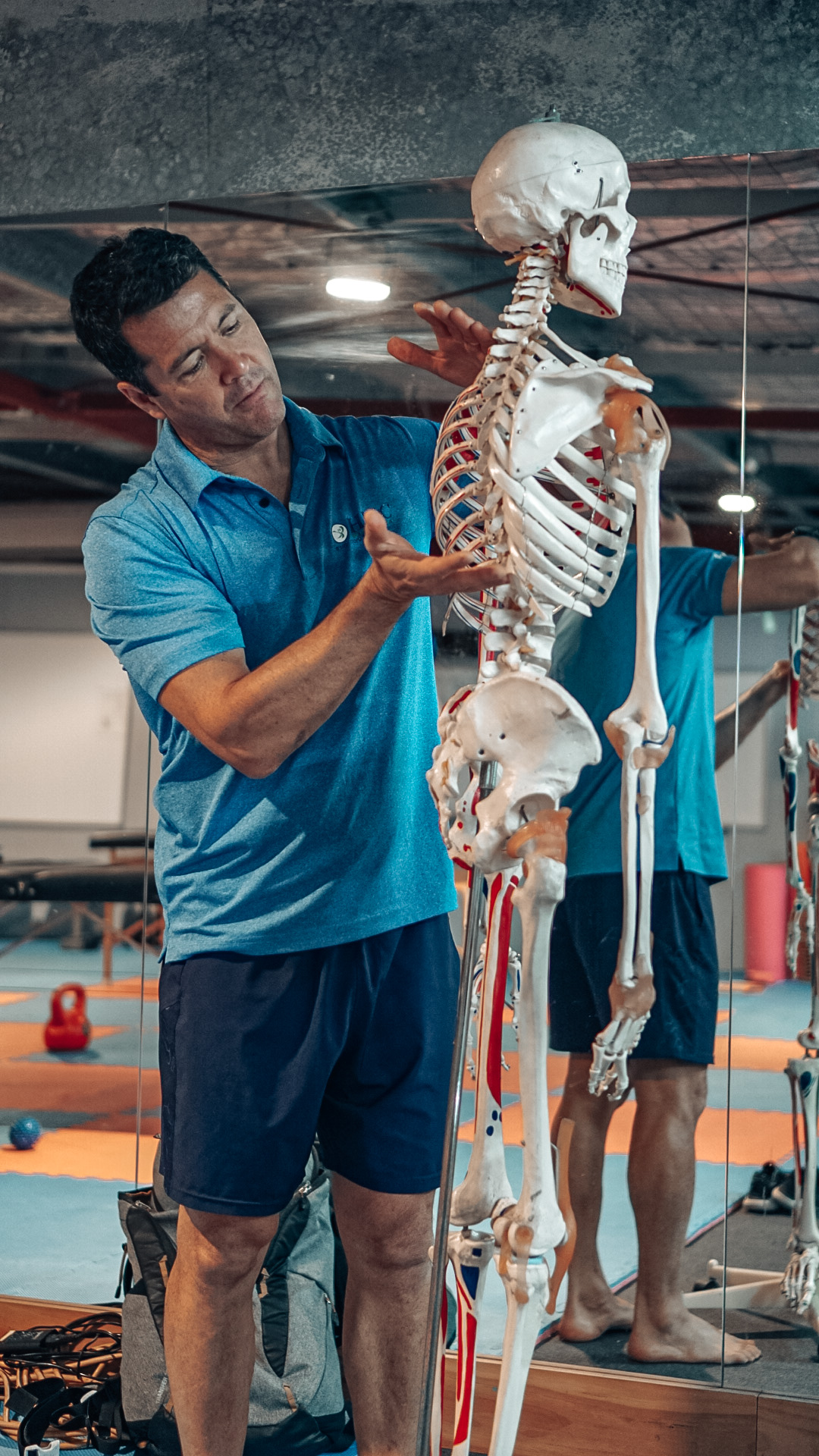
What's Actually Inside
Four things. Everything that used to be two separate memberships is now one.
The deep end. 42 modules.
Body regions, assessment methods, and whole-person systems. Built over more than ten years. Still growing.
Short lessons, written guides and assessment sheets. Made to fit between clients, because that's when you'll actually watch them.
The half nobody taught you
Being good at the work is one skill. Building something around it is another. This is the second one. It used to be a separate membership. Now it's included.
Inside those you'll find the sessions members ask for most:
- How to raise your rates, and hold them
- How to get more clients and fill your groups
- The Business Diagnostic, to find what's really holding you back
- Starting a studio, running group training, adding health coaching
- How to make time to work on your business, not just in it
- Templates you can use: the Perfect Week, the Score Card, quarterly planning
Practical and self-paced. Dip in when you have a problem. No sitting through a course you didn't need.
Fortnightly masterminds and case Q&As
This is where it stops being content. Every fortnight the group works through a topic together. Recent ones: starting your own studio, building group programmes, and earning more as a PT working in a gym.
- Masterminds every fortnight, with real discussion and small groups
- Q&A sessions where you bring the client you're stuck on
- Six years of those sessions recorded. Case studies going back to 2020.
- Everything is recorded, so missing one costs you nothing
You get answers about your business, in the room. Not a generic template.
Somewhere to take the hard one
This is the bit members talk about most once they're in. It's also the bit nobody expects to need. Trainers at your level who'll happily spend twenty minutes on your odd case, because they find it interesting too.
- An active group between sessions. Post the case, get answers.
- Access to Dave and the coaching team
- Work and referrals that come from knowing each other properly
- Live events and hands-on intensives if you want them
Talk it through before you decide anything.
What actually changes
“I have a huge tool set to assess well, rather than intuitively guess.”
Di Lauder · 16 years in the industry, Christchurch
Di had been training people for fifteen years when she joined. She'd just moved cities, she was flat, and she wasn't sure she wanted to keep doing this at all.
What she talks about now isn't more money or more clients, though both came. It's that she found what she loves. She works with runners and running injuries now, and she takes on complicated clients she says she'd have been scared of before.
In her words, she would have run a good personal training business and done just fine. But now she knows she can help the people who walk in with several things going on at once.
That's the change. Not knowing more things. Knowing what you're looking at.
She says one more thing worth hearing. As a solo gym owner, she'd never had anywhere to talk about the hard stuff.
And the part nobody puts on a poster
Being the One They Call Is a Business Model
Look at those cases again. Look at who sent them.
The first golfer came from a client's mate, and the second was sent over by his own specialist. The woman with the back pain walked into an open clinic. The hip client is still coming eight years later, and the pelvis client stayed on after a single session.
None of that came from advertising. It came from being the person who worked out what nobody else could.
That's the honest business case, and it's why the clinical work comes first here. Referrals happen to trainers who fix the one nobody else could.
The business library covers the rest of it: the pricing chat you keep putting off, the group programme you've been meaning to build, the studio you're not sure about. All of it works better when you're already worth referring to.
From the People Already In
Names, faces, own words.
▶ Hear it from members


“Before I joined I was just happily ticking along, doing my own thing — but I didn't really have a clear vision of where I was going.”
Marja Captijn Personal trainer, West Otago — population 1,300“I'd exhausted myself and my knowledge, and I didn't really know where to turn.”
Rich Ellis HMC member“A fantastic mentor. Knows when to push, and knows when to keep you on the straight and narrow.”
Paul Todd Personal trainer, Christchurch“It's incredibly satisfying to be amongst what I'd say is the best of the industry.”
Marja Captijn Personal trainer, West OtagoA straight talk about whether this is right for you.
Before You Book — Is This You?
Two minutes now saves us both a call that was going nowhere.
✓ Book the call if...
- You've got 5+ years behind you and you know there's more in this
- You want to be the one other professionals refer to
- Hard clients interest you more than they scare you
- You're tired of working every hard case out alone
- You'd rather go deep than collect another certificate
- You'll actually do the work
✕ Don't book if...
- You're under two years in. This isn't the right stage yet.
- You want a certificate for the wall
- You only want business coaching, with none of the clinical side
- You want it fast and without effort
- You genuinely prefer working alone
- You're happy where you are, which is a fine place to be
What Actually Happens on the Call
Dave would rather turn you away than take money from someone this isn't right for. So it goes both ways.
▶ Meet Dave before you book
A few minutes with the person you'd be talking to.
What you'll cover
- Where you're really at. The honest version, not the tidy one.
- The clients you're seeing, and the ones you're not sure about
- Whether HMC Elite is right for that, or whether something else is
- If it fits: how it works, what it costs, and where you'd start
- If it doesn't: Dave will point you at something that suits you better
What it isn't
- A high-pressure pitch with a countdown timer
- A commitment. Plenty of people talk and decide it's not their moment.
- A waste of your time if the answer turns out to be no
Pick a time that works around your clients.
🛡️ We Don't Stop at 90 Days
Join. Do the work. Show up. If after ninety days you haven't picked up techniques you're using with clients, found a clearer direction for your business, and stopped feeling like you're doing this alone, we keep working with you until you have. No extra charge. No time limit.
Fair's fair. We'll ask you to show us you actually used the material. We don't want money from trainers who aren't getting anywhere.
The Questions You're Probably Asking
“What does it cost?”
Dave will tell you on the call. In the first few minutes, if you ask. It's not on this page for two reasons. There are several ways to pay, from weekly to yearly, so the honest answer depends on which one suits you. And we'd rather work out if this is right for you before talking money. If it isn't right, the price doesn't matter. If it is, you'll get a straight number and no pressure.
“I've been at this a long time and I still don't feel like the expert.”
We hear that all the time, almost always from trainers who are clearly good at their job. The gap usually isn't knowledge. It's that nobody gave you a reliable way to work out what you're looking at. So every hard case feels like a test you might fail. That's a method problem, not a you problem. And it's much easier to fix in a room full of people who've felt the same way.
“I've been burned by programs that didn't deliver.”
Most of what burns people is content. You buy it, watch some of it, and never open it again. There is a library here and it's a serious one. But the part that changes things is live. Masterminds every fortnight. Case sessions where you bring the client you're stuck on. People who notice when you go quiet. And we're asking you to book a call, not hand over a card, so you can work out if it's real first.
“Can't I just find this online, or ask AI?”
You can find information anywhere, and some of it is good. What you can't find is someone who's done this for thirty years looking at your client and telling you where to look next. Information was never the problem. If it were, you'd have solved this already. Knowing which bit applies to the person in front of you is the whole job.
“Is this technical or business?”
Both. It used to be two separate memberships. The clinical library is the deep end: assessment, body regions, whole-person systems. The business library covers pricing, getting clients, filling groups, starting a studio, and the systems to run it all. Now they're one membership. Most people come for the clinical side, because that's the itch. The business side is what they end up using, once they work out that being good at the job doesn't build the business for you.
“I can't afford time away from clients.”
Nothing here asks you to block out a week. Short lessons between clients. Written guides and assessment sheets you grab when you need them. Every live call recorded. The masterminds are set around real training hours, because everyone in them is training people too.
Pick a time that works around your clients.
The Hard Ones Will Keep Walking In.
The only question is whether you'll know what you're looking at. Book a call with Dave and find out if this is how you get there.
Book a Call With DaveNo pitch. If it's not right for you, he'll say so.
P.S. Three people looked at that golfer's hip. A coach, a specialist and a trainer. They all agreed. They were all wrong. That's not a story about bad trainers. It's a story about how easy it is to look in the wrong place, and how much changes when you know how to look one level down.
P.P.S. If you're not sure, book anyway. Worst case, you spend twenty minutes talking about your work with someone who's done this for thirty years. You leave with a clearer head. That's not a bad worst case.